
Creating a budget is a crucial step towards achieving financial stability. Without a clear understanding of your income and expenses, you may find yourself running out of money before your next paycheck.
Effective budget management enables you to make informed decisions about your money, ensuring that you have enough for your needs and wants. By budgeting, you can prioritize your spending, reduce financial stress, and achieve your long-term goals.
Key Takeaways
- Understand the importance of budgeting for financial stability
- Learn how to create a simple budget plan
- Discover effective budget management tips
- Prioritize your spending to achieve financial goals
- Reduce financial stress through budgeting
Understanding the Importance of a Budget
A well-planned budget is the cornerstone of financial stability and success. It serves as a roadmap for your financial decisions, helping you navigate through the complexities of managing your money.
Having a budget in place can make a significant difference in your financial well-being. It not only helps in tracking expenses but also in achieving your long-term financial goals.
Why You Need a Budget
A budget is essential for taking control of your finances. It allows you to understand where your money is going and make informed decisions about how to allocate your resources.
By creating a budget, you can:
- Identify areas of unnecessary expenditure
- Prioritize your spending based on your financial goals
- Make adjustments to achieve financial stability
Benefits of Budgeting
Budgeting offers numerous benefits, including:
“A budget is telling your money where to go instead of wondering where it went.” – Dave Ramsey
Some key advantages of budgeting include:
| Benefit | Description |
|---|---|
| Reduced Financial Stress | By having a clear picture of your finances, you can reduce stress and anxiety related to money management. |
| Increased Savings | A budget helps you allocate funds towards savings and emergency funds, ensuring you’re prepared for the future. |
| Better Financial Decision Making | With a budget, you can make informed decisions about investments, purchases, and other financial commitments. |
Common Budgeting Myths
Despite its importance, budgeting is often surrounded by misconceptions. Let’s debunk some common myths:
- Myth: Budgeting is too restrictive. Reality: Budgeting is about making conscious financial decisions, not depriving yourself of everything.
- Myth: You need a lot of money to start budgeting. Reality: Budgeting is essential regardless of your income level; it’s about managing what you have effectively.
By understanding the importance of a budget and dispelling common myths, you can take the first step towards achieving financial stability and success.
Setting Your Financial Goals
Setting financial goals is a crucial step in taking control of your financial health. By establishing clear objectives, you can create a roadmap for your budgeting journey, ensuring that your financial decisions align with your priorities.
Financial goals can vary significantly from one person to another, depending on factors such as age, income level, and personal circumstances. However, the process of setting these goals remains largely the same.
Short-Term vs. Long-Term Goals
Financial goals can be categorized into short-term and long-term objectives. Short-term goals are those you aim to achieve within a relatively short period, typically less than a year. Examples include saving for a vacation, paying off a small debt, or building an emergency fund.
Long-term goals, on the other hand, are objectives that take several years or even decades to accomplish. These might include saving for retirement, paying off a mortgage, or funding your children’s education.

SMART Goals Framework
To ensure your financial goals are effective, it’s beneficial to use the SMART goals framework. This means making sure your goals are:
- Specific: Clearly define what you want to achieve.
- Measurable: Quantify your goal so you can track progress.
- Achievable: Ensure your goal is realistic based on your financial situation.
- Relevant: Align your goal with your broader financial strategy.
- Time-bound: Set a specific deadline for achieving your goal.
Prioritizing Your Goals
Once you have identified your financial goals, it’s essential to prioritize them. Not all goals are equally important or urgent, and you may need to allocate your resources accordingly.
| Goal | Priority Level | Timeline |
|---|---|---|
| Building an emergency fund | High | 6 months |
| Paying off credit card debt | High | 1 year |
| Saving for a down payment on a house | Medium | 3 years |
| Saving for retirement | Medium | 20 years |
| Funding a vacation | Low | 1 year |
By prioritizing your goals, you can focus on the most critical objectives first, ensuring that you’re making progress towards achieving financial stability and success.
Analyzing Your Income
Analyzing your income is a crucial step in developing a comprehensive budget plan. It involves understanding where your money comes from and how much you have available for budgeting.
Sources of Income
Your income can come from various sources. For most people, their primary source of income is their salary or wages from a job. However, income can also include:
- Child support
- Alimony
- Freelance work
- Investments
- Rental income
- Any other regular financial inflows
It’s essential to identify all your income sources to get an accurate picture of your financial situation.
Calculating Your Total Income
To calculate your total income, you need to sum up all the money you receive from the various sources you’ve identified. Here’s a simple way to do it:
| Income Source | Monthly Amount |
|---|---|
| Salary/Wages | $4,000 |
| Child Support | $500 |
| Freelance Work | $800 |
| Total Income | $5,300 |
This table illustrates how to tally your monthly income from different sources. By doing so, you’ll have a clear understanding of how much money you have available for budgeting.
Factoring in Irregular Income
If you have irregular income, such as from freelance work or investments that don’t yield consistent returns, you’ll need to estimate your average monthly income. To do this:
- Track your income from these sources over several months to identify a pattern.
- Calculate the average income from these sources over the period you’ve tracked.
- Use this average as your estimated monthly income from these sources in your budget.
By accurately assessing your income, you can create a more realistic and effective budget that aligns with your financial reality.
Tracking Your Expenses
To take control of your financial situation, you need to know how you’re spending your money. Tracking your expenses is a fundamental step in budgeting that helps you understand where your money is going. By monitoring your spending daily, you can ensure that you stay on top of your finances and make informed decisions about your money.
Fixed vs. Variable Expenses
Expenses can be categorized into two main types: fixed and variable. Fixed expenses are those that remain the same every month, such as rent, mortgage payments, and utility bills. On the other hand, variable expenses can change from month to month and include costs like groceries, entertainment, and travel.
Understanding the difference between these two types of expenses is crucial for effective budget management. By identifying your fixed and variable expenses, you can better allocate your income and make adjustments as needed.
Tools for Tracking Expenses
There are various tools available to help you track your expenses. You can use:
- Spreadsheets: Programs like Microsoft Excel or Google Sheets allow you to create custom budget templates and track your expenses.
- Budgeting Apps: Apps like Mint, You Need a Budget (YNAB), and Personal Capital can automatically track your spending and categorize your expenses.
- Expense Logs: Keeping a manual log of your expenses can also be effective, especially for those who prefer a more hands-on approach.
Choosing the right tool depends on your personal preference and comfort with technology. The key is to find a method that you can stick to consistently.
Creating an Expense Log
If you prefer a more traditional approach, creating an expense log can be a simple yet effective way to track your spending. Here’s a basic table you can use:
| Date | Description | Category | Amount |
|---|---|---|---|
| 01/01/2023 | Groceries | Variable | $50.00 |
| 02/01/2023 | Rent | Fixed | $1,000.00 |
| 03/01/2023 | Dinner | Variable | $25.00 |
By regularly updating your expense log, you can gain a clear picture of your spending habits and make necessary adjustments to your budget.
Tracking your expenses daily is a habit that can significantly impact your financial health. By understanding your spending patterns, you can identify areas where you can cut back and allocate your resources more effectively.
Choosing a Budgeting Method
With numerous budgeting methods available, choosing the one that suits your financial situation is key. The right budgeting method can help you manage your finances more effectively, achieve your financial goals, and reduce financial stress.
Zero-Based Budgeting
Zero-based budgeting involves creating a budget from scratch, where every dollar is accounted for. It’s a highly effective method for managing finances, as it ensures that you’re making conscious decisions about how your money is being spent. To implement zero-based budgeting, start by listing all your income sources and expenses. Allocate every dollar towards a specific expense or savings goal, ensuring that your income minus expenses equals zero.
Benefits of Zero-Based Budgeting:
- Complete control over your finances
- Reduced unnecessary expenses
- Increased savings
50/30/20 Rule
The 50/30/20 rule is a simple and straightforward budgeting method. It involves allocating 50% of your income towards necessary expenses like rent and utilities, 30% towards discretionary spending, and 20% towards saving and debt repayment. This method is ideal for those who want a straightforward approach to budgeting without getting too detailed.
The key advantage of the 50/30/20 rule is its simplicity.
Envelope System
The envelope system is a hands-on budgeting method that involves dividing your expenses into categories and allocating cash for each category into separate envelopes. This visual system helps you stick to your budget by making you more aware of your spending. For example, you might have envelopes for groceries, entertainment, and transportation.
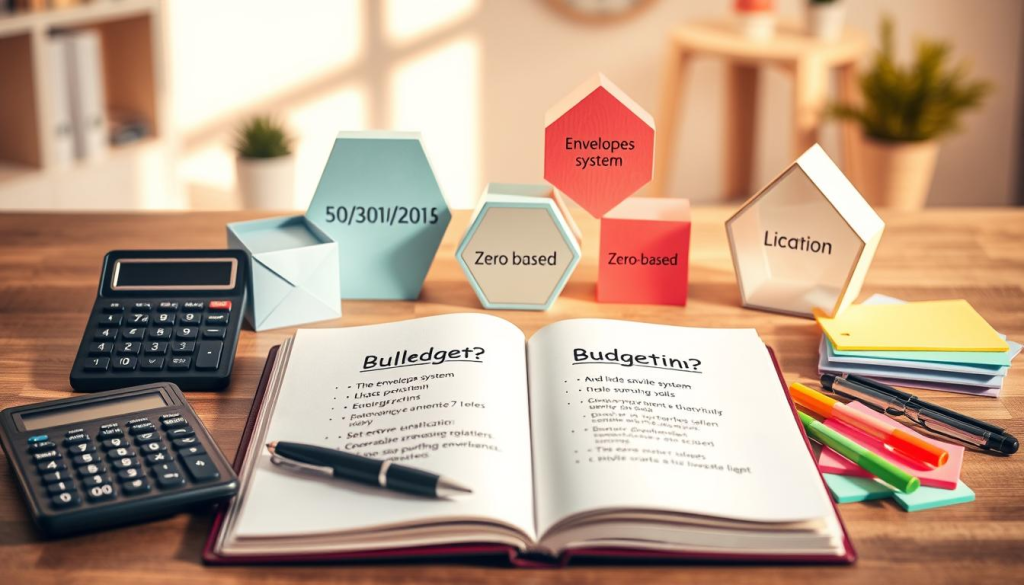
By choosing a budgeting method that fits your lifestyle and financial goals, you can take control of your finances and make progress towards a more stable financial future.
Creating Your Budget Plan
Creating a budget plan that works for you is essential for managing your finances effectively. A well-crafted budget plan helps you understand where your money is going and ensures that you’re making the most of your income.
Making a plan and giving every single dollar a job is the core principle of a zero-based budget. This approach ensures that every dollar is accounted for, whether it’s being saved, invested, or spent.
Step-by-Step Budget Creation
To create a budget plan, start by gathering all your financial documents, including pay stubs, bank statements, and bills. Next, categorize your expenses into fixed and variable costs. Then, assign a job to every dollar you earn, making sure to include savings and emergency funds.
- Identify your income sources
- Categorize your expenses
- Assign a job to every dollar
- Regularly review and adjust your budget
Using Spreadsheets and Apps
Utilizing tools like spreadsheets or budgeting apps can simplify the budget creation process. These tools help you track your expenses, create a budget plan, and set financial goals. Popular budgeting apps include Mint, You Need a Budget (YNAB), and Personal Capital.
“The key to keeping a budget is tracking every single dollar you earn and spend.”
This quote emphasizes the importance of meticulous tracking in maintaining a successful budget.
Reviewing Your Budget
Regularly reviewing your budget is crucial to ensure you’re on track to meet your financial goals. Schedule monthly or quarterly reviews to assess your spending, identify areas for improvement, and make necessary adjustments.
By following these steps and maintaining a commitment to your budget plan, you can achieve financial stability and success.
Adjusting Your Budget
Life is unpredictable, and your budget should be able to adapt to its twists and turns. As your financial situation evolves, it’s essential to regularly review and adjust your budget to ensure it remains aligned with your financial goals.
When to Revisit Your Budget
It’s advisable to review your budget at least once every few months or whenever you experience a significant change in income or expenses. Don’t panic if you go over budget; instead, use it as an opportunity to review your budget and make necessary adjustments.
Regular budget reviews help you stay on track with your financial goals and make adjustments as needed. This could be due to changes in income, expenses, or financial goals.
Incorporating Changes in Income or Expenses
When your income or expenses change, your budget should reflect these changes. For instance, if you receive a raise, you might consider allocating the extra funds towards savings or debt repayment. Conversely, if you’re facing a reduction in income, you may need to cut back on discretionary spending.

It’s also crucial to account for irregular expenses, such as car maintenance or medical bills, by setting aside funds for these potential costs.
Balancing Savings and Spending
Achieving a balance between saving and spending is critical to maintaining a healthy financial outlook. While it’s essential to save for the future, it’s also important to enjoy your money today.
Consider using the 50/30/20 rule as a guideline: Allocate 50% of your income towards necessary expenses, 30% towards discretionary spending, and 20% towards saving and debt repayment.
- Review your budget regularly to ensure you’re on track with your financial goals.
- Adjust your spending habits as needed to accommodate changes in income or expenses.
- Prioritize saving for the future while also allowing for enjoyment in the present.
Building an Emergency Fund
Building an emergency fund is essential for navigating life’s unexpected expenses. An emergency fund serves as a financial cushion, helping you avoid debt and financial stress when unexpected expenses arise.
How Much Should You Save?
Aim to save three to six months’ worth of expenses in your emergency fund. If you have a family, consider saving more to account for their needs. It’s crucial to include contributions to this fund as a line item in your budget to ensure consistent progress.
Key Considerations:
- Assess your monthly expenses to determine your savings goal.
- Consider your job security and income stability.
- Factor in any dependents or financial responsibilities.
Tips for Starting Your Emergency Fund
Starting an emergency fund can seem daunting, but with a clear plan, you can make steady progress. Here are some tips to get you started:
- Begin with a small, achievable goal, such as saving $1,000.
- Set up automatic transfers from your checking account to your savings or emergency fund account.
- Review and adjust your budget to allocate more funds towards your emergency fund.

Accessing Your Fund When Needed
It’s essential to understand when and how to access your emergency fund. Use it only for genuine emergencies, such as:
- Medical emergencies or unexpected health expenses.
- Car repairs or other essential vehicle maintenance.
- Home repairs or maintenance that is urgent.
After using your emergency fund, prioritize replenishing it to maintain your financial safety net.
By following these guidelines and maintaining a disciplined approach to saving, you can build a robust emergency fund that enhances your financial stability and peace of mind.
Staying Motivated
As you embark on your budgeting journey, staying motivated is key to achieving your financial goals. Budgeting is a long-term process that requires consistent effort and commitment. To help you stay on track, it’s essential to implement strategies that foster motivation and accountability.
Setting Milestones
One effective way to stay motivated is by setting clear financial milestones. These milestones serve as benchmarks for your progress, allowing you to track how far you’ve come and what still needs to be achieved. For instance, you might set a milestone to pay off a certain amount of debt within a specific timeframe or to save a particular amount for a down payment on a house.
To make your milestones more effective, ensure they are specific, measurable, achievable, relevant, and time-bound (SMART). This framework helps in creating realistic goals that are aligned with your overall financial objectives.
Celebrating Small Wins
Celebrating small victories along the way is crucial for maintaining motivation. Achieving small milestones, such as successfully reducing your monthly expenses or sticking to your budget for a consecutive month, deserves recognition. These celebrations don’t have to be extravagant; a simple acknowledgment or a small, budget-friendly reward can suffice.
By acknowledging your progress, you reinforce positive financial behaviors and motivate yourself to continue working towards your larger financial goals.
Finding a Budget Buddy
Having a budget buddy can significantly enhance your motivation to stick to your financial plan. A budget buddy is someone who shares similar financial goals and is also committed to budgeting. This could be a friend, family member, or anyone willing to support and be supported in their financial journey.
Regular check-ins with your budget buddy can provide an added layer of accountability. You can share your progress, discuss challenges, and offer support and advice to each other. This camaraderie can make the budgeting process less isolating and more enjoyable.
| Motivation Strategy | Description | Benefits |
|---|---|---|
| Setting Milestones | Creating specific financial goals | Tracks progress, motivates through achievements |
| Celebrating Small Wins | Acknowledging progress along the way | Reinforces positive behaviors, maintains motivation |
| Finding a Budget Buddy | Sharing financial goals with someone for support | Provides accountability, makes budgeting less isolating |
Overcoming Common Budgeting Challenges
Budgeting isn’t just about numbers; it’s about developing strategies to overcome common financial hurdles. As you navigate your financial journey, you’ll inevitably face challenges that test your resolve and budgeting skills.
Dealing with Unexpected Expenses
Unexpected expenses can derail even the most well-crafted budget. To mitigate this, it’s essential to build an emergency fund that can cover 3-6 months of living expenses. This fund acts as a buffer, allowing you to address unexpected costs without compromising your budget.
Consider implementing a monthly allocation to your emergency fund to gradually build up your savings. Utilizing budget planning software can also help you track and manage your emergency fund more effectively.
Avoiding Impulse Purchases
Impulse buying can significantly undermine your budgeting efforts. One effective strategy is to institute a 24-hour cooling-off period before making non-essential purchases. This pause allows you to assess whether the item is something you truly need.
- Deactivate one-click buying on your favorite online shopping platforms.
- Consider using cash for discretionary spending to make the transaction feel more tangible.
- Implement a shopping list and stick to it when you’re at the store.
Staying Committed to Your Budget
Staying committed to your budget requires ongoing effort and dedication. Setting clear financial goals and regularly reviewing your progress can help maintain your motivation.
“The key is not to prioritize what’s on your schedule, but to schedule your priorities.” – Stephen Covey
Using financial planning strategies such as regular budget reviews and adjustments can help you stay on track. Additionally, finding a budget buddy or joining a financial support group can provide the accountability and encouragement you need.
By employing these budget management tips and staying committed to your financial plan, you can overcome common budgeting challenges and achieve your financial goals.
Seeking Professional Guidance
To really take control of your money, consider seeking professional guidance when needed. A financial advisor can provide personalized advice tailored to your financial situation, helping you navigate complex budget planning steps and creating a budget template that suits your needs.
Expert Advice
Consult a financial advisor when facing intricate financial decisions or when you’re unsure about financial planning strategies. They can help you optimize your budget and provide insights into investment opportunities.
Budgeting Resources
For those who prefer self-directed learning, numerous resources are available, including online budgeting tools and financial literacy programs. These resources can guide you in creating a budget template and offer tips on managing your finances effectively.
Enhancing Financial Literacy
Educational tools, such as financial planning courses and workshops, can significantly enhance your understanding of financial planning strategies. By leveraging these resources, you can make informed decisions about your money and achieve your financial goals.